
Caribbean and Diaspora News Round-up
- UK facts and figures on slavery
- St Lucia honours bravery, journalism and trade development
- Haitians witness 'Baby Doc' in the dock
- Trinis join world betting on the next pope
 Slavery’s legacy in figures
This week’s publication of a new study by University College London of British slave owners has reopened the national debate on slavery and reparations.
The study, based on three years of research, indicated the amount of compensation paid to slave owners after slavery had been abolished in 1833.
Those receiving payments from the £20m (US$30m) compensation pot for the loss of their slaves after abolition included the ancestors of Prime Minister David Cameron and the author George Orwell.
The study found ship records which indicated that about 12 billion people were transported from Africa to the Americas from the 16th Century to 1807, when the trade was banned.
The research work also provided a database for people to trace their own ancestors’ role in the slave trade, either as traders or those traded.
Jamaican-born British MP Diane Abbott urged people via Twitter to use the base to see if they could find out about their ancestors.
Others saw the database as the reopening of the reparations debate.
“Mr David Cameron, British Prime Minister: Where are my forty acres and a mule?” wrote the former equalities adviser to the mayor of London, Lee Jasper, in his blog.
Mr Jasper outlined how he had traced his ancestors via Jamaica to the Kru nation – today known as the nations of Sierra Leone and Liberia.
The previous week, veteran historian Sir Hilary Beckles had made the case for reparations in London outlining his research into the case for “Britain’s black debt”.
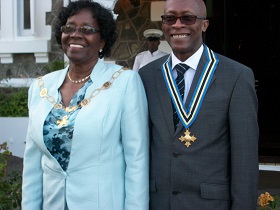
Bravery, journalism and trade feature in St Lucian honoursBravery and long-standing work in the fields of journalism, sports and trade development featured in St Lucia’s annual independence investiture ceremony held this week in Castries.
The highest honour – the St Lucia Cross – was awarded to former diplomat and trade advocate Edwin Laurent.
Mr Laurent is a former Eastern Caribbean High Commissioner to Brussels and was a major advocate in the long-running trade battle over banana export arrangements to Europe.
He later served as a specialist on trade and development at the Commonwealth Secretariat in London.
The St Lucia Medal of Honour (Silver) went to national rugby players Jerry Charles and Wedrel St Clair who, in 2012, saved a 13-year-old girl when she got into difficulty swimming. The two men had just completed their training in the Choc Beach area and jumped in to save her.
Receiving the St Lucia Medal of Merit (Silver) was veteran journalist and sports administrator Joseph “Reds” Perreira, whose voice as a sports commentator has featured in broadcasts for decades across the Caribbean.
ADVERTISEMENT
Haitians finally see Duvalier in courtMany Haitians could not believe their eyes.
They shared their surprise on social media that Jean Claude “Baby Doc” Duvalier was in court, facing allegations of crimes against humanity relating to his 15-year rule in Haiti.
For others, the questions could not be tough enough as Mr Duvalier faced a grilling from a team of judges, while international human rights representatives, victims and their relatives looked on from the court benches.
Mr Duvalier, together with his father and predecessor as President, “Papa Doc”, has been depicted as presiding over a reign of terror, enforced by the shadowy secret police known as the Ton Ton Macoutes.
Human rights groups have catalogued the torture and deaths of hundreds of people under Mr Duvalier’s rule.
In response to his questioning, Mr Duvalier said he had left Haiti a “better country” after his rule.
“Murder existed in all countries. I did not intervene in… policies,’ he told the court on 28 February.
Outside the court, the images of 20th Century dictatorship clashed with 21st Century communications.
Supporters gathered outside the courtroom to shout “Long Live Duvalier”.
On social media, there was little support to be found for Baby Doc.
“Who’d have thought #Duvalier would be forced one day to face his victims,” said one person on Twitter.
“Haitians will remember image of #Duvalier having to answer questions about the repression carried out under his rule,” said another.
“After the hearing today, #Haiti Justice system should be declared grossly incompetent to handle the #Duvalier cases, no solid question asked,” concluded another.
In a poll for the Miami Herald newspaper, people were asked whether the court should now charge Jean-Claude Duvalier with human rights abuses.
Reflecting Miami’s large Haitian exile community, 88% said “yes”.
ADVERTISEMENT
Trinis betting on the PopeIn recent times, the religion which gave the world the phrase of certainty (“Is the Pope Catholic?”) has delivered much uncertainty.
And the confusion that followed the first resignation of a pope for 600 years has caught the imagination of countries that are fond of the odd wager.
In “betting-mad Britain”, as news agency AP described it, bookmakers have been busy taking bets on the man to replace Benedict XVI.
AP said that the favourite at the British bookies was Cardinal Peter Turkson of Ghana, with other contenders for British gamblers being Italian Cardinals Angelo Scola and Tarcisio Bertone and Canada’s Marc Oullet.
In Trinidad, too, the bets are on for the choice of the new pope.
In an article headlined ‘Place your bets$!’, Trinidad’s Newsday newspaper reported that Trinis were not only betting on the next pope, but also how long the College of Cardinals at the Papal Conclave will take to elect a new pope.
According to Newsday, Trinidadian gamblers are also putting money on Cardinals Scola, Bertone, Turkson and Ouellet.
The story annoyed some commentators in the face of a rising murder rate and civic protests in the twin-island republic.
“A lead story of a national paper is about people betting on who will be the new pope? With so many issues in THIS country? #baffling” tweeted Sam Nanton, the Deputy Head of News at Trinidad’s TV6.
Newsday followed up with a 1 March story pointing out that bets on the new pope in the US and Europe were expected to reach tens of millions of dollars.